Mica Band Heater
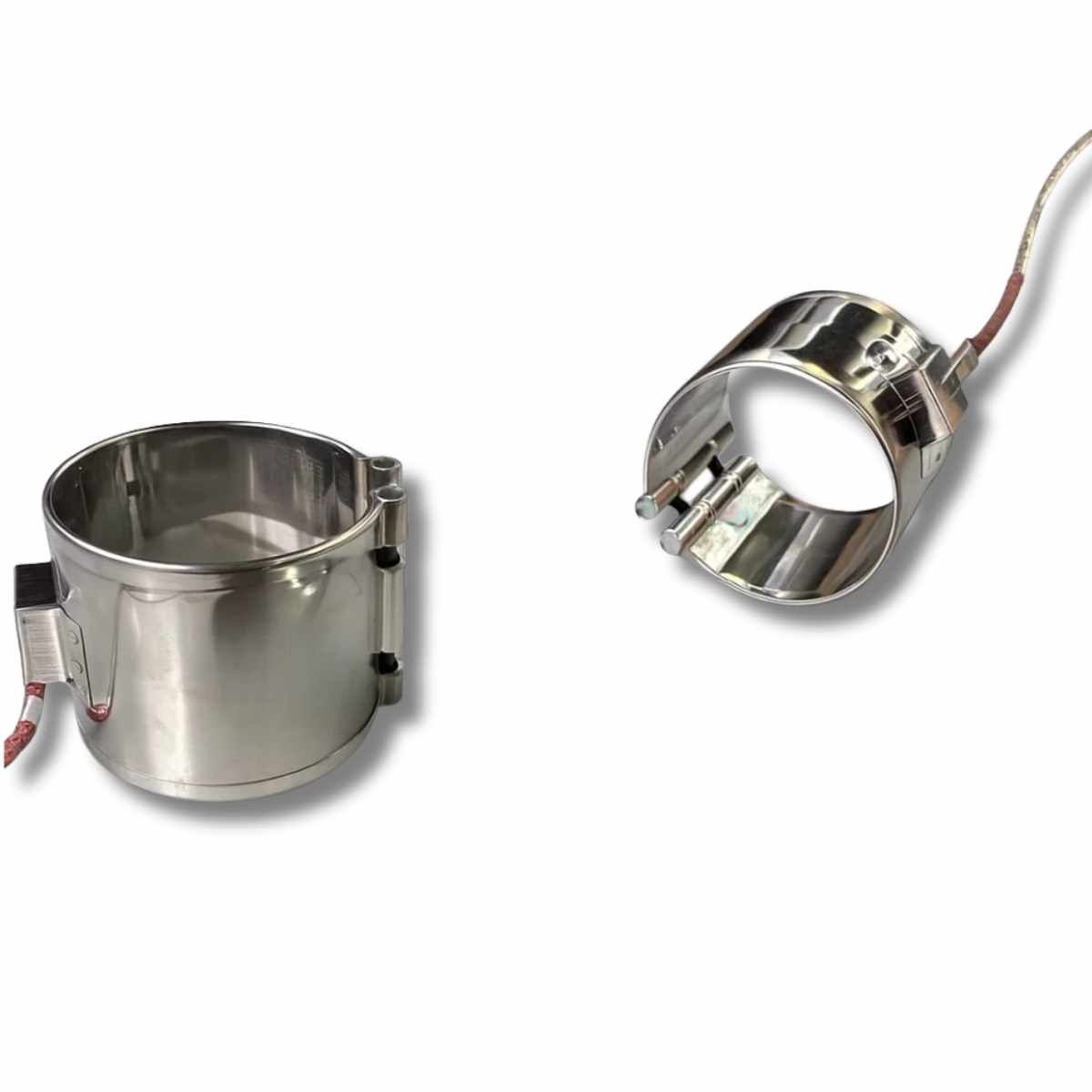
A mica band heater is the thin, fast type of band heater. Flat nickel-chrome ribbon is wound over a mica sheet, covered with more mica and closed inside a stainless steel band about three millimetres thick. It heats an injection barrel quickly and cheaply, and we supply it for working temperatures up to 300 °C.
- Max temperature
- up to 300 °C
- Thickness
- 2.5 to 3.5 mm
- Watt density
- 3 to 6 W/cm²
- Inner diameter
- 50 to 1500 mm
- Response
- Fast
- Custom builds
- Any diameter, width and cut-out
Ask for a Price or Technical Advice
Call us or send a WhatsApp message for a price, full specifications, or a custom build.
Technical Specifications
The figures below are the usual ranges for this type of element. Builds outside them are possible.
| Property | Value |
|---|---|
| Construction | Flat nickel-chrome ribbon wound over mica, covered with mica, closed in a stainless band |
| Insulation | Mica sheet, both sides of the element |
| Band material | Stainless 304 |
| Max working temperature | 300 °C |
| Total thickness | 2.5 to 3.5 mm |
| Inner diameter range | 50 to 1500 mm |
| Width range | 50 to 1000 mm |
| Safe watt density | 3 to 6 W/cm² |
| Clamping | Barrel nut, wedge lock, or latch and strap |
| Working voltage | 24, 220 or 380 V |
| Termination | Post terminals, fibreglass leads with stainless braid, or a European box |
| Power tolerance | +5 to -10 % |
Sizes and Specifications We Supply
| Property | What we supply |
|---|---|
| Inner diameter | 50 to 1,500 mm |
| Width | 50 to 1,000 mm |
| Maximum power per element | 4,000 W |
| Voltage | 24, 220, 380 V |
| Sheath material | Stainless steel |
| Maximum working temperature | 300 °C |
| Built-in thermocouple | On request |
| Delivery | 3 working days |
| Minimum order | 1 piece |
Where It Is Used
- Plastic injection moulding
- Packaging machinery
- Extruder and blow-moulding barrels
- Pipe and cylinder heating
Choosing, Fitting and Looking After It
Thin is the feature, not a compromise
A mica band heater is about three millimetres thick, and everything it is good at comes from that. There is almost no mass between the ribbon and the barrel, so heat crosses quickly and the zone follows the controller closely. On a machine that runs different materials at different setpoints, that responsiveness is worth more than the extra ceiling a ceramic band would give.
The same thinness is why contact matters so much. There is no ceramic body to even out a bad patch — what is not touching simply overheats.
The ceiling is real
Mica is an insulator up to a point and then it is not. Past about 450 °C it starts to break down, and the first sign is usually an earth-leakage trip rather than an open circuit. Watch the overshoot, not just the setpoint: a zone set at 420 °C with a controller that overshoots by 40 is spending part of every cycle above the limit, and the heaters in that zone will keep dying while the setpoint looks safe on paper.
That is why the figure we quote is 300 °C working rather than 450. Those 150 degrees of headroom are where the controller’s overshoot and the bad patches of contact have somewhere to go.
Watch the gap in the band
A band heater does not close into a full circle; there is a gap where the two ends meet at the clamp. That gap has no element behind it, so it is always the coolest part of the circumference. Set the gap where it does least harm — not over the thermocouple boss, and not lined up with the gap of the heater in the next zone, or the barrel gets a cold stripe running down its length.
Leads and their braid
The lead exit is where a barrel heater is most often damaged, because it is what sticks out into the machine. On a barrel that gets purged, hot plastic falls onto whatever is below it, and a bare fibreglass lead does not survive that. Ask for a stainless braid over the leads on the lower zones, and route them upward and away from the purge path.
Fitting order on a multi-zone barrel
Work from one end and keep the heaters in order — they are usually not identical, because the front zones are narrower and the feed zone often carries a different wattage. Mixing them up puts the wrong power in the wrong place, and the symptom is a zone that will not hold temperature no matter how the controller is tuned. Mark each heater as it comes off.
When to replace one that still works
A mica heater near the end of its life often still heats, just less. If a zone has slowly started to lag its neighbours over a few months, measure the resistance of its heaters and compare against the others of the same size. A reading that has drifted upward is a heater on the way out, and changing it during a planned stop costs a great deal less than changing it mid-run.
Price
Price
From 800,000 Toman
Prices checked — confirm the figure before ordering, as it moves with the exchange rate and with the specification.
What Sets the Price
- Diameter and length
- Power and voltage needed
- Sheath material (stainless steel, brass and so on)
- Termination type and lead or thread length
- Whether a thermocouple is built in
- Order quantity
How It Compares
Mica against the ceramic band it is usually weighed against.
| Feature | Mica | Ceramic |
|---|---|---|
| Max working temperature | 300 °C | 500 °C |
| Thickness | About 3 mm | 25 to 35 mm with insulation |
| Response | Fast | Slower |
| Tolerance of poor contact | Low | Higher |
| Cost | Lower | Higher |
Common Questions
How long does a mica band heater last?
On a machine where the barrel is round and the clamp is kept tight, years. Where it fails in months the cause is mechanical almost every time, not the heater — the same machine will eat replacements until the barrel surface and the clamp are dealt with.
Can it be used above 300 °C?
The mica itself insulates to about 450 °C and loses its strength above that, at which point the heater goes to earth. We quote 300 °C working so the controller's overshoot still sits inside that margin. For a hotter zone, the answer is a ceramic band heater.
Why is it so thin?
Because the mica is a very good insulator in a very small thickness. That thinness is the whole point: less mass to heat means the zone reaches temperature faster and responds to the controller quickly, which suits a machine that changes setpoint between jobs.
What clamping should I choose?
A barrel nut for small and medium diameters, a wedge lock where the heater has to be pulled up hard and evenly, and a latch and strap where it has to come on and off often. Larger diameters are usually made in two halves.
Can a heater be made with a cut-out for the thermocouple?
Yes, and it should be. Say where the boss sits, measured from one edge of the band and round from the gap, and the heater is built with a hole or a notch there. Cutting one afterwards damages the ribbon or the mica behind it.
Related Products
Band Heater
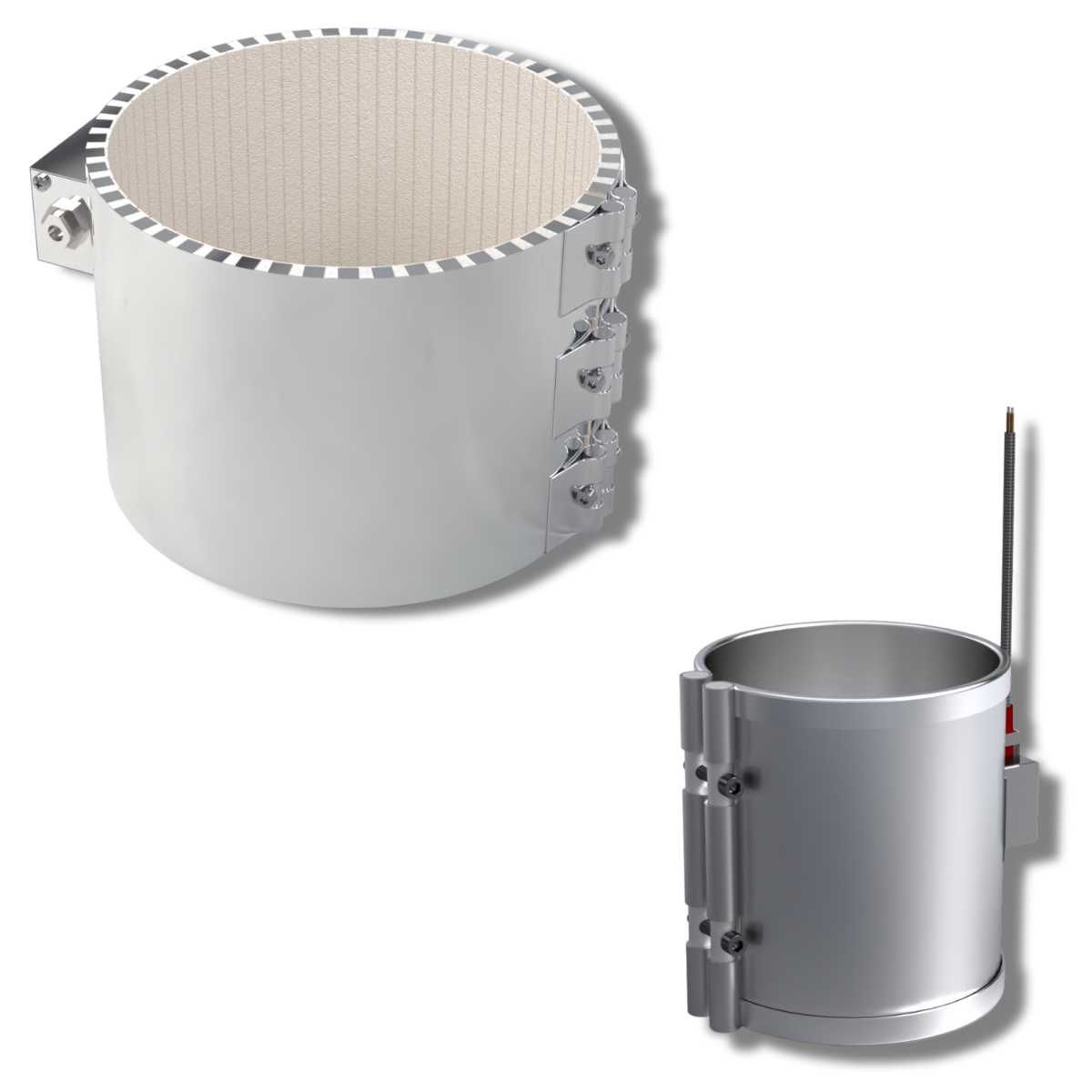
A band heater is a ring-shaped element that clamps around a cylinder and heats it through its wall. Resistance wire sits on mica or inside a ceramic body, wrapped in a stainless steel band that is pulled tight by a clamp. It is the element that heats injection barrels, extruder zones, nozzles and pipes.
Ceramic Band Heater
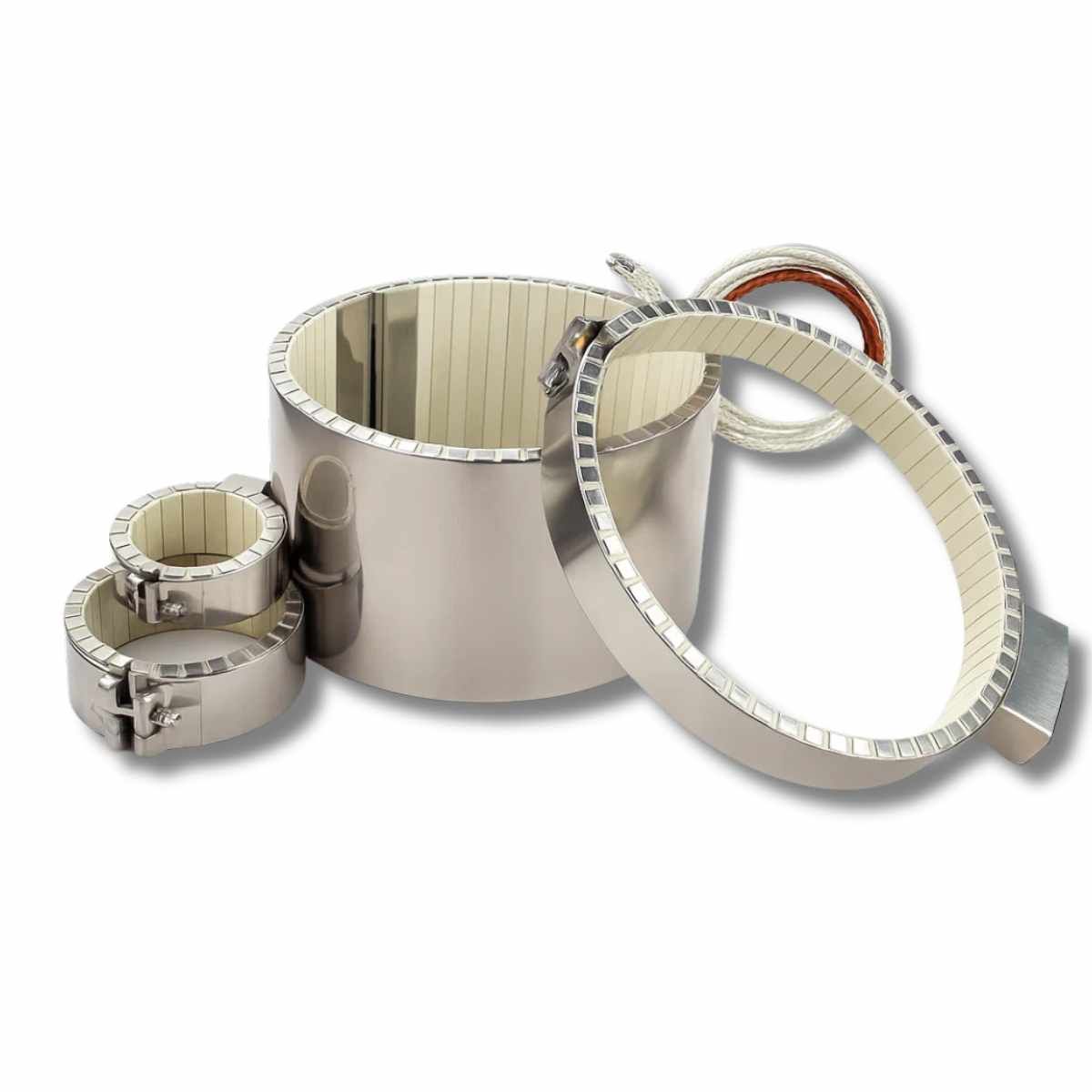
A ceramic band heater carries its resistance wire threaded through interlocking ceramic bricks, with a ceramic fibre blanket and a stainless frame behind them. We supply it for working temperatures up to 500 °C, it keeps heating even where contact with the barrel is imperfect, and its built-in insulation means less of its heat is lost to the workshop.
Nozzle Heater
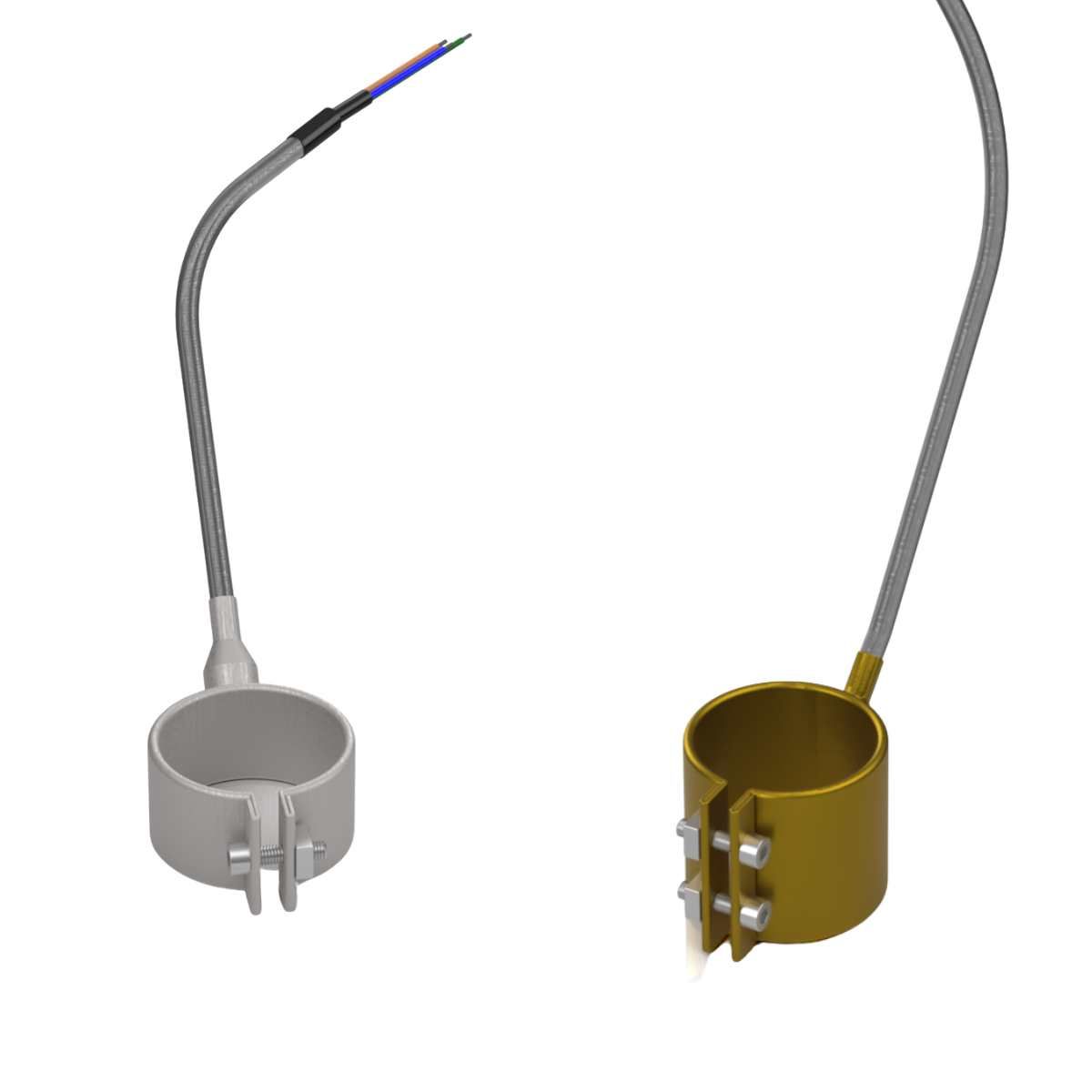
A nozzle heater is a small, narrow band heater made for the tip of an injection machine or a hot runner nozzle. It wraps a diameter of only 15 to 60 mm, often carries its own thermocouple, and holds the melt at temperature through the last few centimetres before it enters the mould.
Ask for a Price or Technical Advice
Call us or send a WhatsApp message for a price, full specifications, or a custom build.
Last updated: