Plate Heater
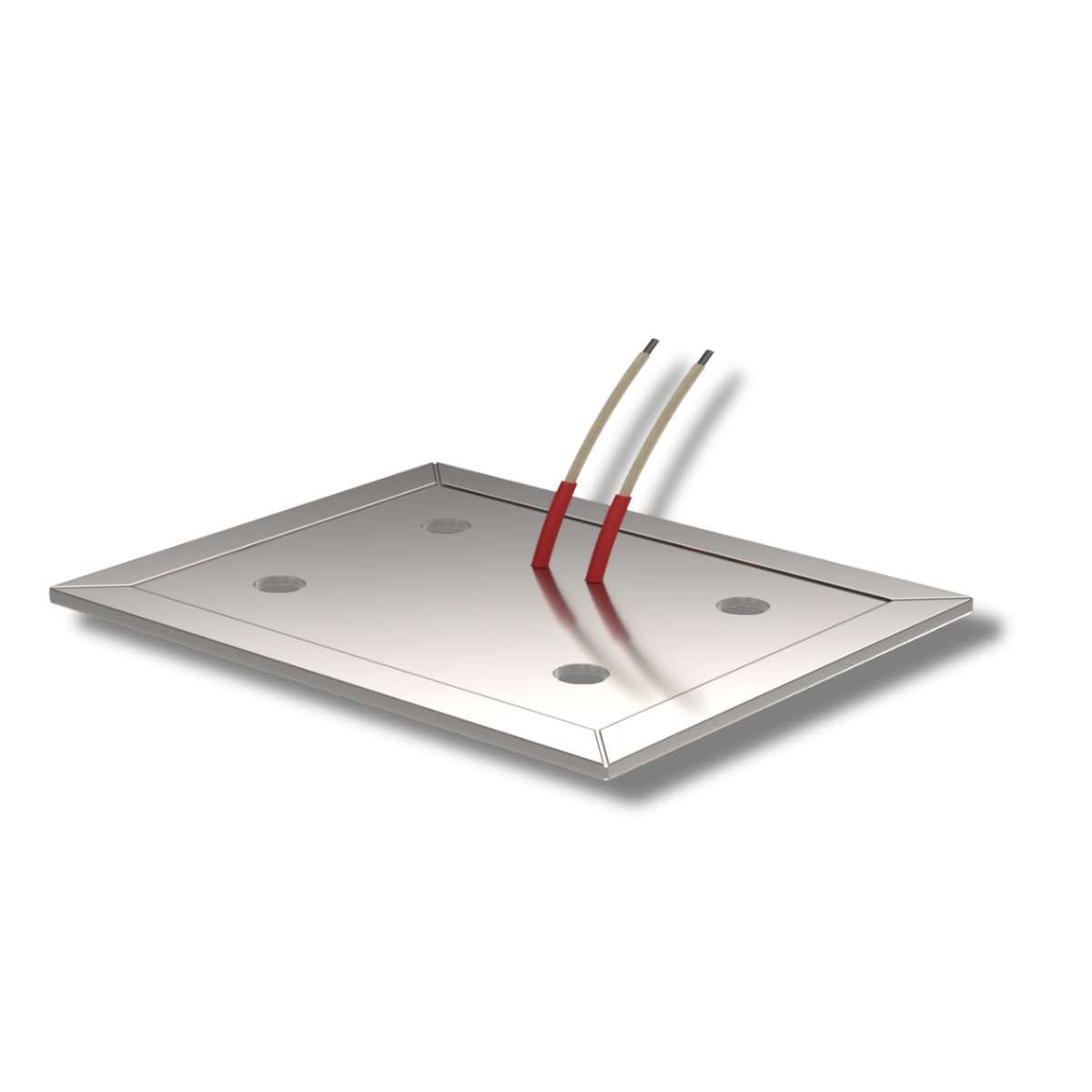
A plate heater is a wide flat element that heats an area rather than a line. A resistance circuit is spread across a rectangular plate — clamped between metal sheets or cast into aluminium — so the whole face comes up to temperature together. It is used under vessels, moulds, tables and heated surfaces.
- Heats
- A whole surface, not a line
- Max temperature
- 250 (cast) to 600 (clamped) °C
- Watt density
- 1 to 4 W/cm²
- Build
- Clamped assembly or cast aluminium
- Voltage
- 220 / 380 V
- Custom builds
- Any plate size and fixing pattern
Ask for a Price or Technical Advice
Call us or send a WhatsApp message for a price, full specifications, or a custom build.
Technical Specifications
The figures below are the usual ranges for this type of element. Builds outside them are possible.
| Property | Value |
|---|---|
| Construction | Resistance circuit spread across the area, clamped between metal sheets or cast into an aluminium plate |
| Plate material | Stainless, mild steel, or cast aluminium |
| Max working temperature | 250 (cast aluminium) to 600 (clamped, ceramic insulated) °C |
| Safe watt density | 1 to 4 W/cm² |
| Plate thickness | 8 to 25 mm |
| Flatness needed on the mating surface | Within a few tenths across the plate mm |
| Working voltage | 220 single phase or 380 three phase V |
| Sensor | Pocket drilled in the plate for a thermocouple or a thermostat bulb |
| Fixing | Through-holes or tapped bosses, to your pattern |
| Termination | Terminal box on the back or the edge, away from the heated face |
| Power tolerance | +5 to -10 % |
Sizes and Specifications We Supply
| Property | What we supply |
|---|---|
| Size on each side | 100 to 800 mm |
Where It Is Used
- Laboratory equipment
- Food and pharmaceutical industry
- Plastic injection and forming tools
- Heated tables, benches and work surfaces
- Vessel and reactor bases
Choosing, Fitting and Looking After It
The circuit layout is the specification
With a strip heater you choose watts and length. With a plate heater the thing that decides whether it works is how the circuit is laid across the area — how close the runs sit, how they turn at the ends, how much closer they come near the edges. A plate with an evenly pitched circuit and no compensation at the edges will always read cooler around the rim, because an edge loses heat on two faces instead of one.
So describe the job, not just the power: what has to be at temperature, how evenly, and whether the edges matter. A plate that is even in the middle and falls off at the rim is fine under a beaker and useless under a mould.
Thickness buys evenness
Heat spreads sideways through the plate. A 20 mm plate evens out a circuit that a 6 mm plate would print straight through as visible hot lines. If the surface temperature has to be uniform and the plate is thin, either the circuit has to be denser or the plate has to be thicker. Thicker also means slower to heat, which is usually an acceptable trade.
Cast aluminium when the plate has to be machined
A cast plate is one piece of aluminium with the element inside it. That is what lets it be faced, drilled and tapped after the fact, and it is why cast plates end up in tooling and test rigs where a clamped assembly could not be modified. The price is the ceiling: aluminium is not a 400 °C material, and a cast plate run near its limit distorts.
Mount it flat and let it grow
A plate heater bolted down hard at four corners onto a surface that is not flat will bow, and once it bows it is only touching in places. Bolt from the centre outward, use slotted or oversized holes at the outer fixings, and check the mating surface with a straight edge first. Large plates need this more, not less — a 400 mm plate grows by well over a millimetre between cold and 300 °C.
Insulate the back or heat the room
Half the output of an uninsulated plate goes the wrong way. Ceramic fibre or a calcium silicate board behind it costs little, sends that half back towards the work, and keeps the frame and the fixings from running at plate temperature. It also stops the fixing bolts becoming the fastest heat path out of the assembly, which is a common reason a plate reads correct at the sensor and cold at the corners.
Sensor placement changes the whole result
Put the sensor at the centre and the controller holds the hottest spot at setpoint, leaving the rest cooler. Put it at the edge and the middle overshoots. About a third of the way in from an edge is the usual compromise, and where the work sits matters more than symmetry — control the point you actually care about.
Price
Price
The price for this product depends on the specification you order.
What Sets the Price
- Diameter and length
- Power and voltage needed
- Sheath material (stainless steel, brass and so on)
- Termination type and lead or thread length
- Whether a thermocouple is built in
- Order quantity
How It Compares
The two ways a plate heater is built.
| Feature | Clamped | Cast aluminium |
|---|---|---|
| Max temperature | Up to 600 °C | Up to 250 °C |
| Evenness of the face | Good | Very good |
| Machining | Limited | Can be machined, drilled and tapped |
| Repair | Element can be replaced | Replace the whole plate |
| Cost | Lower | Higher |
Common Questions
When do I need a plate heater instead of two strip heaters?
When the whole face has to be at the same temperature, and the plate is too thin to spread heat on its own. Strips heat lines and rely on the metal to even them out; a plate heater puts the circuit across the whole area, so thin plate stops being a problem.
What is a cast aluminium plate heater?
A tubular element is formed into a pattern and molten aluminium is cast around it. The result is one solid plate with the heat spread through it, and it can be machined afterwards — drilled, tapped, faced. Aluminium sets the ceiling at about 250 °C.
How even is the temperature across the face?
That depends on the circuit layout and the plate thickness, not on the wattage. A well laid out plate on a thick enough base holds within a few degrees across the middle. Every plate is cooler at the edges, because the edges lose heat on two sides.
Where should the sensor go?
In a pocket drilled into the plate, roughly a third of the way in from an edge — not dead centre, which is the hottest point, and not at the edge, which is the coolest. Say when ordering where the pocket should be and what sensor goes in it.
Can the plate be drilled for my fixings?
Yes, if it is drilled at build time. A finished heater must not be drilled afterwards — the circuit is spread across the area, so there is no safe spot. Send the fixing pattern with the order and the plate is built around it.
Does it need insulating behind?
Almost always. A bare plate sends as much heat backwards as forwards. A layer of ceramic fibre or a calcium silicate board behind it turns that back towards the work and stops the machine frame becoming a radiator.
Related Products
Flat and Strip Heater
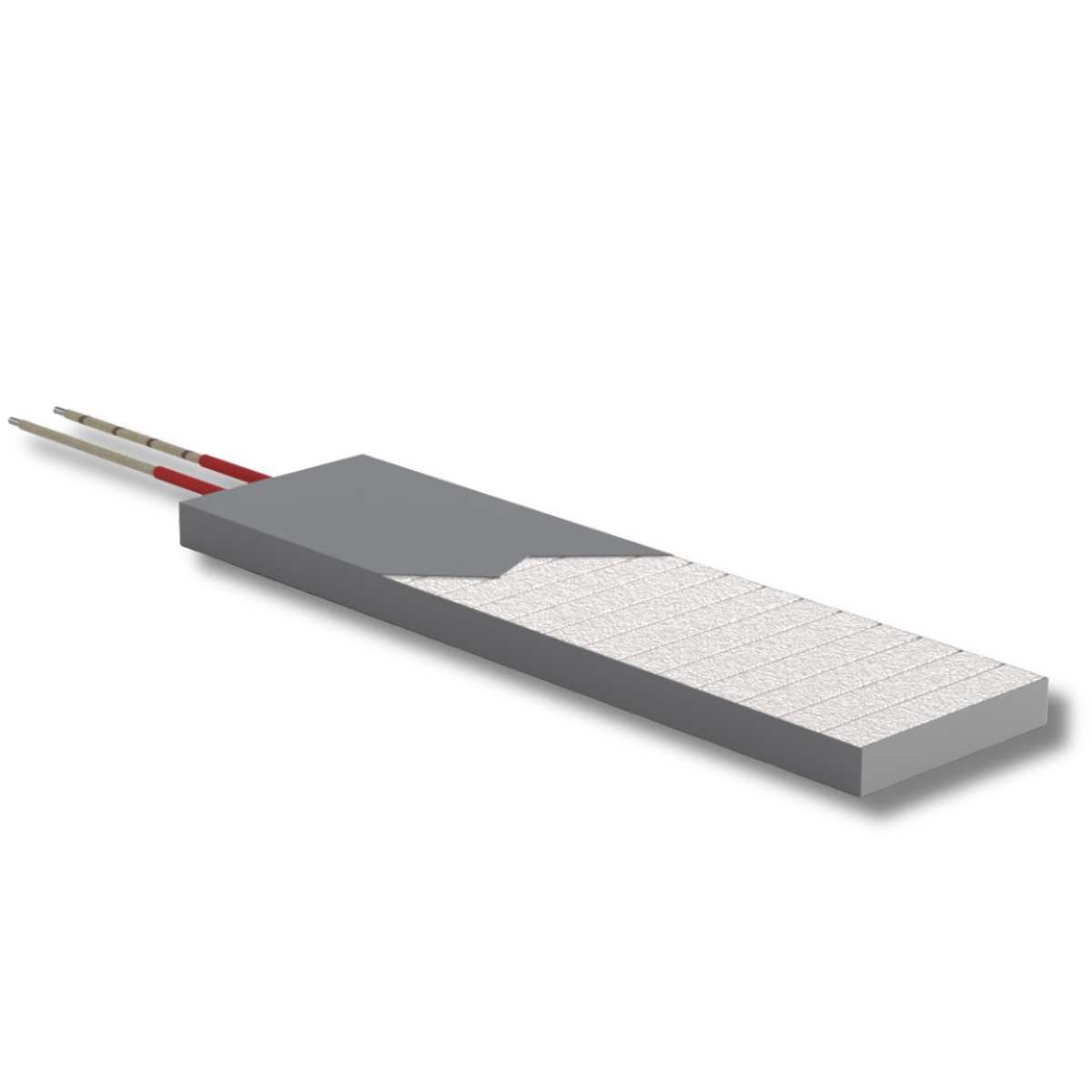
A flat or strip heater is a rectangular element that bolts against a flat surface and heats it by contact. Resistance wire sits on mica or in compacted magnesium oxide inside a steel or stainless case. It is the element used wherever the thing being heated is a plate, a bar or a platen rather than a liquid or a pipe.
Strip Heater
A strip heater is a long, narrow flat element, usually 25 to 60 mm wide, that bolts along a bar, an edge or a plate and heats it in a line. Fitted with fins it becomes an air heater instead, and it is the simplest way to add heat to a surface that has no room for anything thicker.
Heat Press Heater
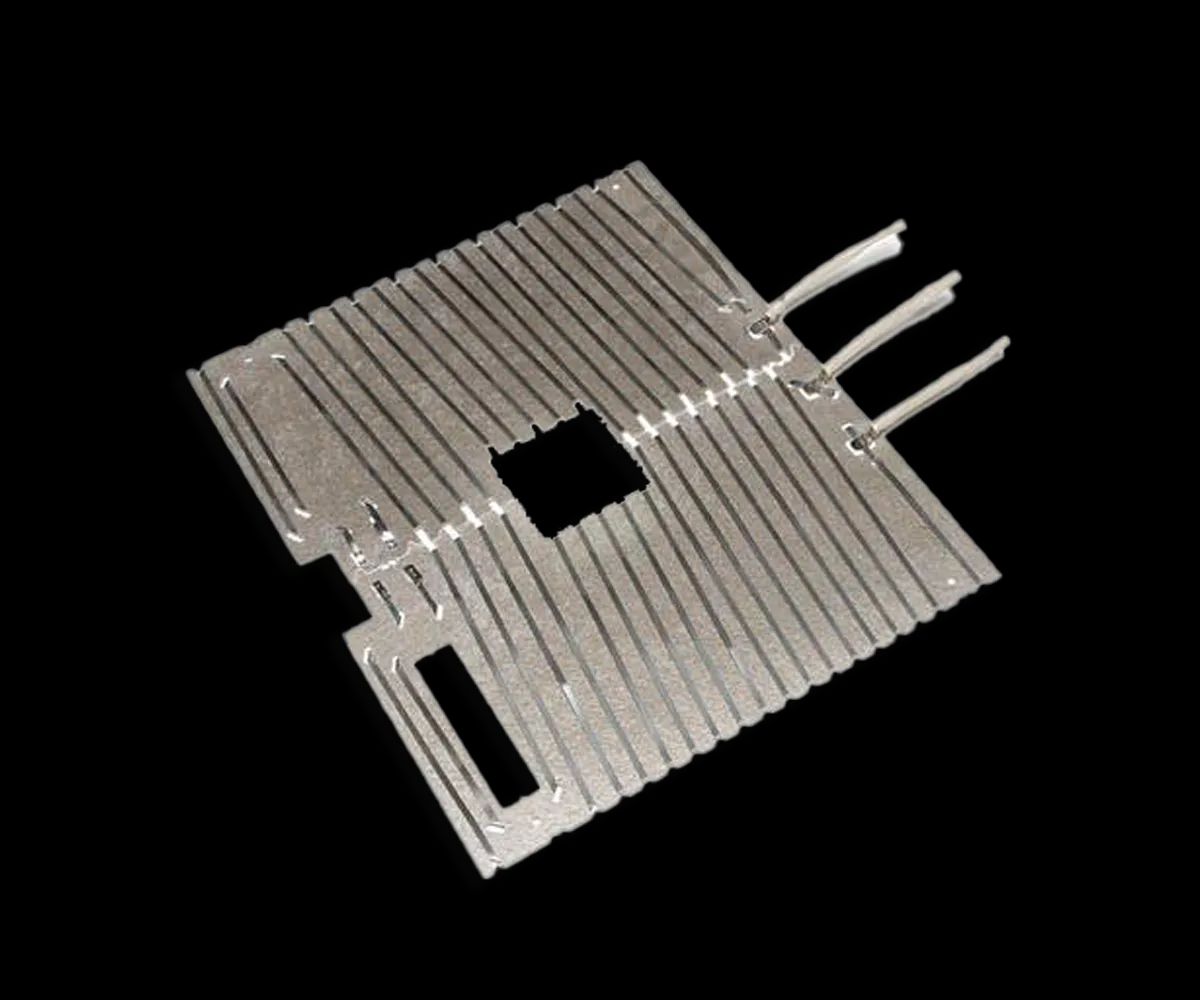
A heat press heater is the element built into the platen of a press — a heat transfer press, a laminating press, a hot stamping or a vulcanising machine. Its whole job is an even temperature across the pressing face, because everything the press makes is only as good as the coldest corner of that face.
Ask for a Price or Technical Advice
Call us or send a WhatsApp message for a price, full specifications, or a custom build.
Last updated: