Quartz Heater
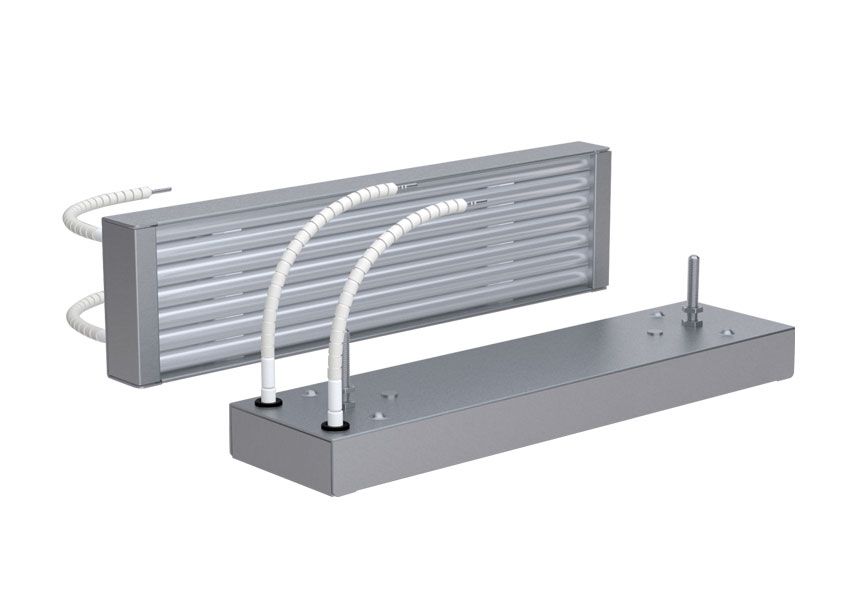
A quartz heater is a coiled resistance wire inside a clear quartz tube. The tube reaches 900 to 1200 °C and radiates medium-wave infrared, which most plastics, coatings and water absorb well. It reaches working output in a second or two and is the general-purpose radiant element for drying and forming.
- Wavelength
- Medium wave infrared
- Element temperature
- 900 to 1200 °C
- Response time
- 1 to 3 s
- Tube diameter
- 10 to 33 mm
- Voltage
- 220 / 380 V
- Custom builds
- To your tube length and fittings
Ask for a Price or Technical Advice
Call us or send a WhatsApp message for a price, full specifications, or a custom build.
Technical Specifications
The figures below are the usual ranges for this type of element. Builds outside them are possible.
| Property | Value |
|---|---|
| Construction | Coiled nickel-chrome or iron-chrome-aluminium wire suspended inside a clear or opaque quartz tube |
| Element temperature | 900 to 1200 °C |
| Wavelength | Medium wave, around 2 to 3 micrometres |
| Response time | 1 to 3 s |
| Tube diameter | 10, 14, 23 and 33 mm |
| Tube length (general industry range) | 200 to 2000 mm |
| Working voltage | 220 single phase or 380 three phase V |
| Control | Thyristor or solid state relay |
| Reflector | Polished aluminium, or a white opaque coating on the back of the tube |
| Mounting | Ceramic end caps in sprung holders that allow the tube to expand |
| Termination | Braided high-temperature lead from each end cap |
| Power tolerance | +5 to -10 % |
Where It Is Used
- Packaging machinery and shrink tunnels
- Plastic thermoforming and sheet heating
- Air and duct heating
- Paint, powder and ink drying
- Preheating before bonding or welding
Choosing, Fitting and Looking After It
The tube is the fragile part and it needs room to move
Quartz grows as it heats and shrinks as it cools, and it does that thousands of times. Holders must let one end slide. Anything that pins both ends — a too-tight clamp, a tube pushed into a housing that has closed up, an end cap bolted hard — cracks the tube on an early cycle, usually near an end cap where nobody thinks to look.
Long tubes also sag. Above about a metre they want support at the middle, or they bow towards whatever is beneath them and touch it.
Fingerprints are a real failure mode
Skin leaves salt and oils on the quartz. At 1000 °C that mark changes the structure of the glass at that spot, and the tube devitrifies and fails there. Fit tubes with clean gloves, and if a tube has been handled, wipe it down with alcohol before the first run. This is one of the few maintenance rules that is absolute rather than a matter of degree.
Medium wave is what most work actually absorbs
Water, most plastics and paint films take up medium-wave infrared in the top fraction of a millimetre of the surface. That is exactly where the heat is wanted for drying, shrinking and forming. It is why quartz is the default radiant element for a shrink tunnel or a drying line, while short-wave halogen belongs on metal and long-wave ceramic on gentle, even work.
It can be turned down as well as off
Unlike a halogen lamp, a quartz tube has no minimum output it must run above. A thyristor can hold it at twenty per cent all day. That matters on a line that runs at different speeds, or one that idles between batches — instead of cycling full on and full off, the bank can simply sit at a lower power, which is gentler on the tubes and steadier for the process.
Replace a bank together and keep the spacing honest
A tube that has been in service puts out slightly less than a new one. Mix them and the work gets a pattern. Where the tubes make up one heating zone, change them as a set and note the date.
Spacing matters as much as power. The rule of thumb is to space tubes at roughly the distance between the tubes and the work, so the patterns overlap by the time they arrive. Wider than that gives stripes; much closer and the tubes see each other, which raises their own temperature above what they were designed for.
Keep water off a hot tube
A cold splash onto a tube at working temperature cracks it immediately. On lines where the product is wet, or where there is washdown nearby, either guard the tubes or interlock the heaters so they are off while the area is being cleaned. This is the failure that most often gets blamed on tube quality.
Price
Price
The price for this product depends on the specification you order.
What Sets the Price
- Diameter and length
- Power and voltage needed
- Sheath material (stainless steel, brass and so on)
- Termination type and lead or thread length
- Whether a thermocouple is built in
- Order quantity
How It Compares
Quartz against the two radiant types either side of it.
| Feature | Quartz | Halogen | Ceramic |
|---|---|---|---|
| Wavelength | Medium | Short | Long |
| Response | 1 to 3 seconds | Under a second | Minutes |
| Absorbed well by | Plastics, water, coatings | Metals, dark surfaces | Plastics, gentle even heat |
| Fragility | Glass tube | Glass lamp | Robust ceramic |
Common Questions
What is the white coating on the back of some tubes?
An opaque quartz coating that acts as a built-in reflector, sending the radiation that would have gone backwards towards the work instead. It saves fitting a separate reflector in tight spaces and it cannot get dusty in the way a polished one can.
How should the tube be mounted?
In holders that let it grow along its length. A quartz tube lengthens noticeably as it heats, and if both ends are clamped rigidly it cracks on the first cycle. Sprung or sliding holders at one end are the normal arrangement, and long tubes need support in the middle.
Can a quartz heater be dimmed?
Yes. With a thyristor the output can be varied smoothly from zero, and there is no minimum operating point to respect — unlike a halogen lamp. That makes quartz the easier choice where the process needs the power turned down rather than switched off.
Should all the tubes be replaced together?
In a bank that works as one zone, yes. A used tube has a slightly different output from a new one, and mixing them leaves an uneven pattern across the work. Replacing a bank together also means one shutdown instead of several.
How far apart should tubes be spaced?
Close enough that their patterns overlap on the work, typically at a spacing similar to the distance from tube to work. Too far apart and the work comes out striped; too close and the tubes radiate onto each other and run hotter than intended.
What breaks a quartz tube in service?
Three things, in order: fingerprints left at fitting, rigid clamping that does not allow expansion, and cold water or wet product splashing onto a hot tube. All three are avoidable, and none of them are the element's fault.
Related Products
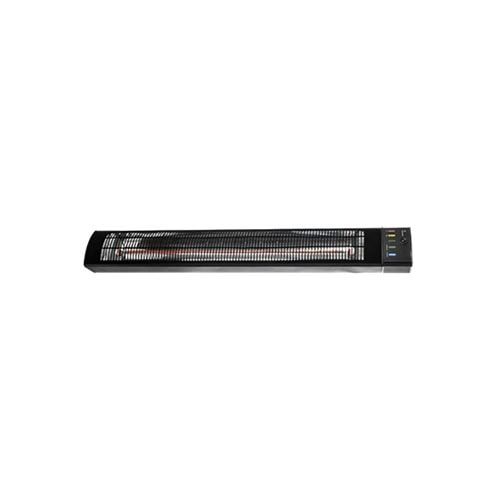
Radiant Heater
A radiant heater warms an object by infrared light rather than by touching it or by heating the air between them. A quartz tube, a halogen lamp or a ceramic face glows, and the surface facing it absorbs that energy directly. It is used where something has to be heated quickly, across a gap, without contact.
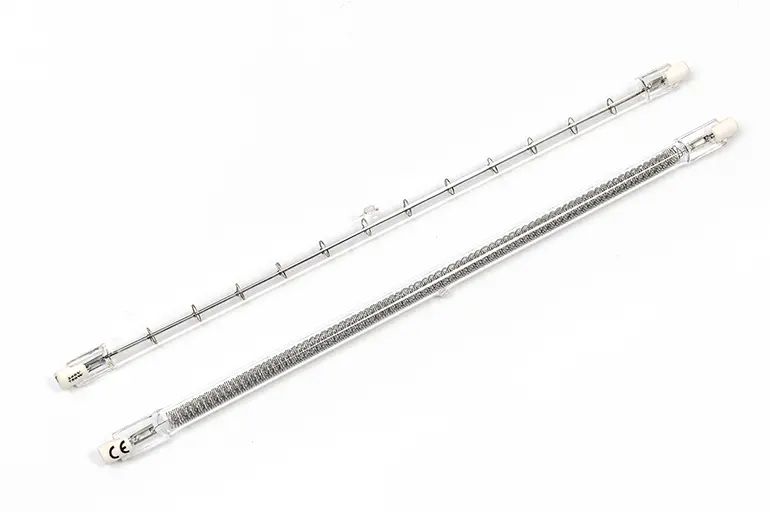
Halogen Heater
A halogen heater is a tungsten filament in a halogen-filled quartz lamp, running at up to 2200 °C. It emits short-wave infrared, reaches full output in under a second, and goes cold almost as fast. It is chosen where heat has to be intense, local, and switched on and off with the process.
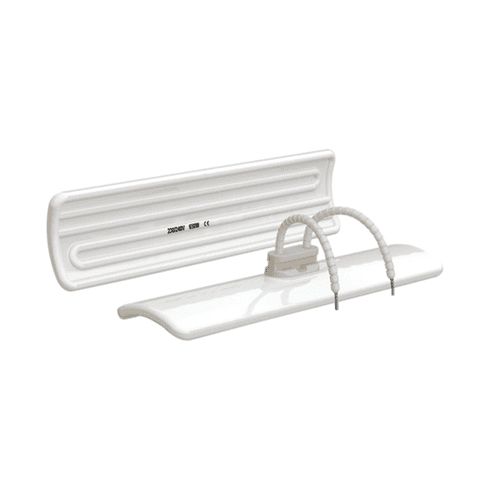
Ceramic Infrared Heater
A ceramic infrared heater is a resistance coil embedded in a glazed ceramic body that radiates long-wave infrared from a face running at 300 to 750 °C. It is slow, steady and robust, and it is the radiant element used where plastic has to be heated evenly without being scorched.
Ask for a Price or Technical Advice
Call us or send a WhatsApp message for a price, full specifications, or a custom build.
Last updated: