Difference Between Flange Cartridge and U-Shaped Heaters
Compare flanged cartridge and U-shaped immersion heaters: element geometry, heat transfer, surface watt density, maintenance, and choosing a design for your process.
A flange cartridge heater uses straight heating elements, while a flanged U-shaped heater uses tubular elements that bend back toward the flange. Both can heat liquids in tanks and circulation systems, and a heater of either type can be built to the same kilowatt rating. The choice affects how much heated surface fits through the vessel opening, how the fluid moves around the bundle, and what has to come apart when an element fails.
The comparison here covers industrial flanged immersion heaters. In both designs, the flange bolts to a mating connection on the vessel, and an external terminal enclosure houses the electrical connections.
How a flange cartridge heater works
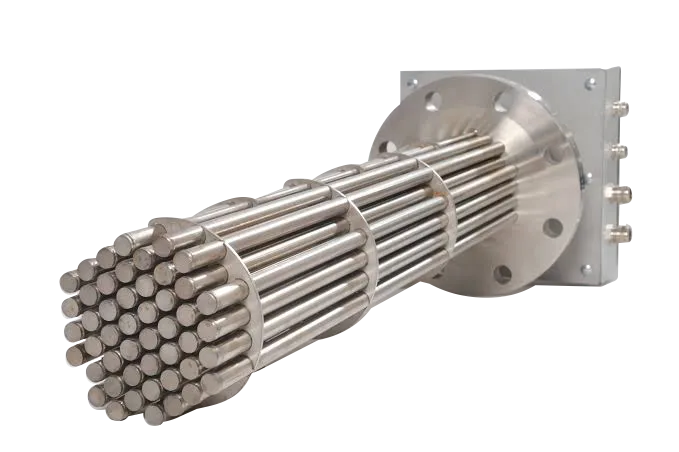
The straight cartridge bundle fits through a single flanged opening.
Straight cylindrical elements project from the flange into the vessel. A typical metal-sheathed cartridge contains a resistance wire surrounded by an electrical insulator that conducts heat, such as compacted magnesium oxide. In a direct-immersion assembly, the cartridge sheaths contact the fluid. In a dry-well design, the cartridges slide into sealed metal sleeves, and heat passes through the sleeves to the liquid. The sleeves form the wetted surfaces.
The straight geometry allows multiple elements to fit into a compact bundle. The spacing still matters. A tightly packed bundle may fit through a small nozzle, but viscous fluid can move slowly between the elements and carry away less heat. For a dry-well heater, the fit between the cartridge and the sleeve also affects heat transfer. An excessive gap adds thermal resistance and can make the cartridge run hotter for the same heat output.
How a flanged U-shaped heater works
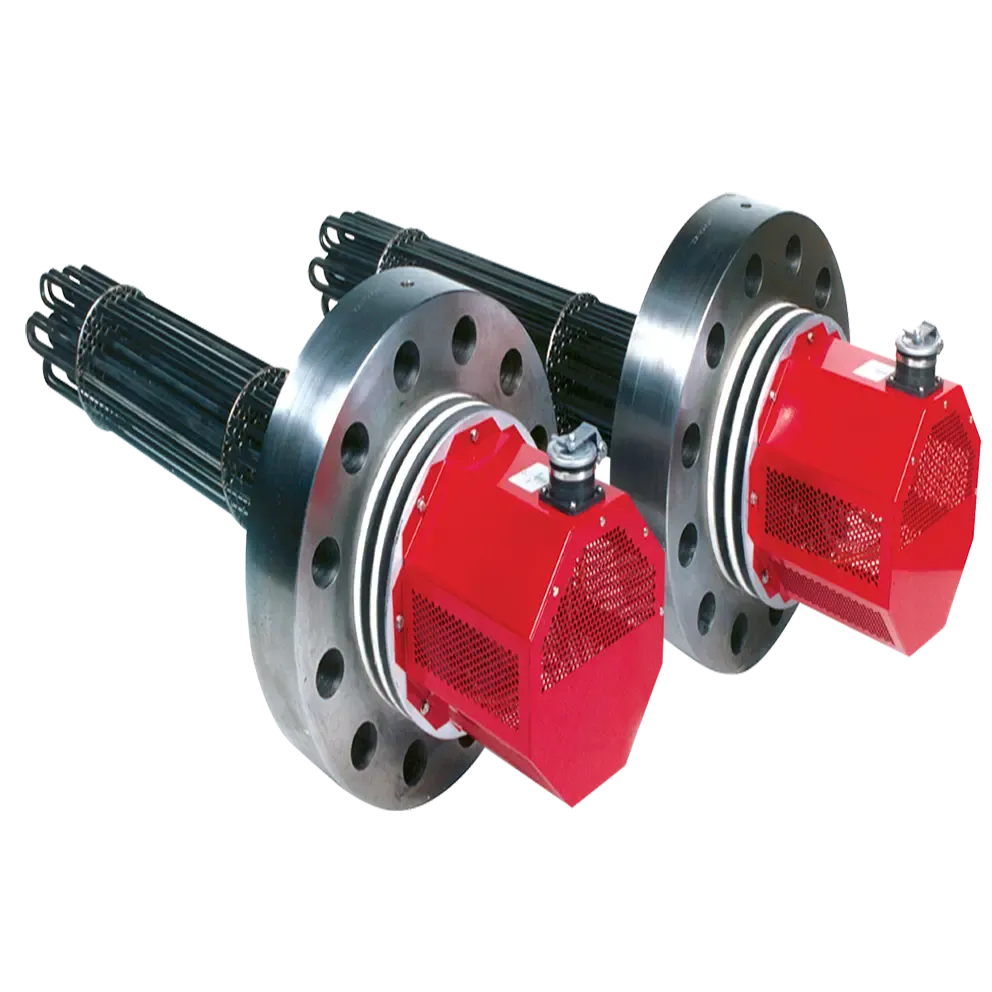
The tubular elements loop back toward the flange, where both ends connect electrically.
Each tubular element forms a U, with two straight legs joined by a return bend. Both ends pass through the same flange, where they are commonly welded or brazed in place. The tubular sheath transfers heat directly to the surrounding liquid. Manufacturers can vary the tube diameter, leg length, bend radius, and spacing to suit the opening and the space inside the vessel.
U-shaped bundles are widely used in hot-water tanks, rinse tanks, and circulation heaters. They can also heat oils when the sheath material, surface watt density, and fluid movement suit the application. Long, well-spaced legs can provide a large heated area and room for liquid to move between the tubes. The same geometry requires enough room beyond the flange to accommodate the bends and enough space outside the vessel to withdraw the bundle.
Power, watt density, and heat transfer
Total power determines how much heat the unit can supply. Surface watt density describes how much power is released per unit of active surface area, usually in W/cm² or W/in². For example, a 12 kW heater with 3,000 cm² of active wetted surface averages 4 W/cm². With 6,000 cm², the same power averages 2 W/cm². Both units supply the same nominal output, but the second distributes it over twice the surface area. For a dry-well assembly, check which surface the manufacturer uses for its watt-density rating.
The distinction matters in oil service. A viscous oil may carry heat away from the surface slowly, especially at cold start or low flow. Excessive surface temperature can degrade the oil and leave carbon deposits. In water service, mineral scale can insulate the heating surface and raise its temperature. Bundle spacing, fluid circulation, and provision for cleaning can therefore affect service life as much as the choice of element geometry.
Maintenance and replacement
A dry-well cartridge assembly can reduce downtime if the cartridges are individually accessible and the sealed sleeves can stay in place. In that design, a failed cartridge may be changed from the terminal side without draining the vessel, following the manufacturer’s service procedure. The drawing should show which parts can be withdrawn, how much clearance they need, and whether the sleeves remain in place.
A U-shaped bundle typically has welded or brazed elements. Servicing it often means isolating the vessel, lowering the liquid level or draining it as required, and withdrawing the full assembly. The cost of a replacement bundle is only one part of the comparison. On a line that runs continuously, the time needed to shut down, drain, refill, and bring the system back up to temperature may matter more than the price of the heater.
Comparison at a glance
| Feature | Flange cartridge heater | Flanged U-shaped heater |
|---|---|---|
| Element geometry | Straight cylindrical elements | Tubes with two legs and a return bend |
| Surface in contact with the liquid | Cartridge sheath or sealed sleeve, depending on design | Tubular element sheath in direct-immersion designs |
| Typical service approach | Individual removal in serviceable dry-well models | Full bundle withdrawal in common welded or brazed designs |
| Main fit check | Bundle diameter, element spacing, and cartridge extraction clearance | Bundle diameter, bend clearance, and bundle extraction clearance |
Choosing for a specific process
Start with the liquid, desired heat-up time, operating temperature, and required power. Include the minimum liquid level or flow, fluid chemistry, and operating pressure when comparing designs. Have the supplier confirm the wetted materials, surface watt density, heated and unheated lengths, flange rating, electrical supply, and the provisions for temperature and low-level or low-flow protection.
A flanged U-shaped assembly is a practical starting point for a water tank with ample clearance and planned maintenance shutdowns. A serviceable dry-well cartridge design is worth comparing for an oil reservoir that is costly to drain. In either case, ask for a drawing that shows the heated length, spacing, and withdrawal route. Those details tell you whether the heater can deliver its rated output in your process and be removed when it needs service.
Technical references
Related Articles
Types of Industrial Heating Elements: A Complete Guide
Discover the main types of industrial heating elements — tubular, cartridge, ceramic, immersion, and band heaters — and learn which one fits your application.
Industrial Heating Elements: Types, Selection, and Applications
A complete technical guide to industrial heating elements — covering element types, materials, watt density, installation methods, and how to select the right solution for your process.